
123 OY
-
1-2-3 OY PC Game
HOME PAGE
Download (1.7 Mb ) the free pc version of 2 QUICK OY, one of the 10 games in the set of 1-2-3 OY!.
It will run on Windows 95, Windows 98, Windows ME, Windows NT 4.0 SP4 and Windows 2000, Windows XP, Windows 7, as well as on the Mac under Virtual PC or other emulation software.
Pleasesend your suggestions. (Originally written in September, 2001)
"The President's Game of OY!"
(you can call it the fuzzy math game if you like)
To become a state representative or even the President you need votes and good math skills. Since our President is so concerned about education we decided to help him by using one of our math card games in a setting in which he would feel at home. Your objective is to win the most votes and upload them to our online polling booth (still under construction) to compete with the other candidates.
The Setup:
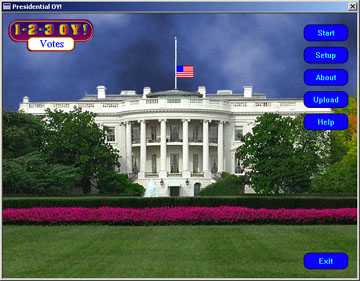
First Window
Votes - these are displayed in the top left corner and are received with each correct mathematical solution to the cards that are displayed.
Menu - the menu choices are displayed down the right hand side
Flag - the flag indicates how many chances for error you have left, each time you score it will rise and it will descend a little for each error or missed opportunity. If it descends all the way, your election game is over.The game is very easy. There are 18 different cards, they are numbered 0 to 16 and a wild OY! card. Go to the SETUP menu and select the highest numbered card you would like to play. Then select which mathematical skills you would like to use from addition, subtraction, multiplication and division. It is highly recommended you start by selecting only addition and the cards from 0 to 8 as the longer you play the game, the faster it gets.
The greater the number of cards and mathematical skills you select under SETUP and the longer you play, the greater the amount of votes you can collect.
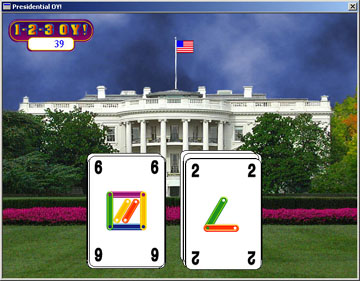
The Game
Cards are dealt alternately to one of 2 stacks of cards. We are a 2 party system?. You must use the math methods you have selected in SETUP to find all the possible combinations of the 2 cards. For example let's say the 2 cards are a 6 and a 2. Well, 6+2 is 8, 6-2 is 4, 6÷2 is 3 and 6x2 is 12. So if the next card dealt is any one of these solutions and you are using all 4 basic methods then you are required to mouse click any where on the screen.
If the next card is not a winner (for example it is a 1 which replaces the 2) then you use the number 1 combined with the 6 to find your next correct solutions ( 7, 5 or 6). The OY card is a wild card and is a winner no matter what the combination. If you mouse click the correct answer you are awarded points which count as votes.
There are many distracting comments made from the White House and Politics is not always fair, so don't expect our game to be.
Good Luck.
© August 2001
-
1-2-3 OY!
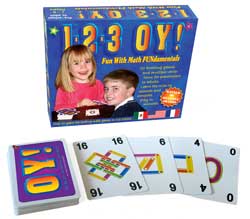
Order Here
Used in thousands of schools for remedial through gifted students, in classrooms and for activity and afterschool programs. Instructions for the ten different games are now listed by grade level in English, French and Spanish.FOR AGES 4 TO ADULT. 1-2-3 OY! dramatically improves fast mental arithmetic, quickly builds confidence and encourages teamwork. Teachers, parents and students, remedial to advanced, love this unique collection of ten dynamic math card games. The flexible rules and optional use of addition, subtraction, multiplication and division will challenge the best of the best and help the most math phobic. The instructions have been reviewed and edited by a world authority on games and past senior editor of GAMES Magazine and now include comprehensive information for educators at both school and home. Each game is presented with numerous variations which are easily adapted to players abilities. Each game is clearly defined by grade level, difficulty and speed. The cards range from zero to sixteen and include five wild OY! cards. The faces of the 90 cards include drawings representing their numbers to assist parents in the introduction of numbers to very young children. Cards are coated for long term durability and because there are five of each the loss of a few will not unduly affect the playing of the games.
Download the free pc version of 2 QUICK OY, one of the 10 games in the set of 1-2-3 OY!.
-
1-2-3 OY! Awards
Selected for a Preferred Choice Award by Creative Child Magazine in their 2004 Toy Creative Toys competition.
Presented the 2003 Gold Award by the National Parenting Publications Awards (NAPPA) for Children's Resources.
Listed by the Eisenhower National Clearinghouse for curriculum use.
Selected by the National Association for Gifted Children's "Parenting for High Potential" Magazine as a "2002 Holiday Toy List" pick.
Awarded the prestigious DR. TOY Award
GAMES Magazine "GAMES 100" Award. Used in thousands of schools for remedial through gifted students, in classrooms and for activity and afterschool programs. Instructions for the ten different games are listed by grade level in English, French and Spanish.
Selected for use by the Harvard University After School Program.
-
1-2-3 OY! competition 2005
Congratulations to all those that competed in the second district 1-2-3 OY! competitions on May 21, 2005 in Painsville, Ohio.
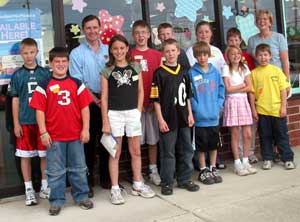
Math Coordinator-Karen LeScoezec, and Don Green
Max Magil, Don Green, Olivia Carrol, Michael Chernesky -
1-2-3 OY! Competitions
1-2-3 OY! School Competitions
1-2-3 OY! competitions have been successfully implemented in 6 schools in the Painesville, Ohio School district during the month of May 2004 and May 2005. This was organized by Math Co-ordinator Karen Lescoezec. We at Dream Green are very grateful for all her work and she has said that she would be happy to answer any questions from teachers regarding these competitions. Please fill in our contact form and we will pass on your requests to her.Students really enjoy the games and this is of primary importance. Before starting the program it will be very useful to evaluate students abilities and then track their improvements over the course of a month or more. If you have any results please forward them to us.
Benefits
Students enjoyed practicing the game and got better with their basic facts.Student confidence rose accordingly and their desire to learn improved.
A small token award was offered for the best sport in every class. There were classes that the students played so well together that it was impossible to choose one student. Students were complemented on their sportsmanship.
Very few students quit trying with most taking on the challenge and many practicing at any opportunity and at home.
Awards
The final competition was hosted by The Learning Corner, an education store in Painesville, OH. Certificates, ribbons and gift certificates were awarded to all contestants, and Pizza and drinks were supplied after the tournament. If you are planning competitions contact your local educational store and or solicit a small donation from a local business to support the contests with prizes and refreshments.
Game Format
We now suggest that you include both a modified form of Quad OY! and Slap Match OY! in your competitions. Quad OY! requires no time pressure but considerable ability. There are many students who approach problems with more deliberation than the speed players, so by scoring both games equally and adding the scores together a more reliable indication of ability is achieved.
Originally we based the competitions on the game of Slap Match OY! using only addition and subtraction, but the target number was turned over by the teacher. We played 4 rounds of 5 minutes with all tables starting and finishing together, except in the finals when we played an extra round with 2 target cards that were added together. At the end of each round the total number of cards each student won was recorded with the top 2 from each class going on to the semi finals. At the semi finals the top 3 went on to the finals, with the top 2 competing and the third player as an alternate.
Position tables into groups of 3 students and place a letter with each group. Hand out a different number to each student which is used to designate which students play together, since the students move to different tables with each round so that each student plays every other student.
Quad OY!
The following rules are modified from the original for competition use. This game has no time requirements and can be played solitaire for practice. We suggest only 3 players per deck of cards.
Play to win the most cards. Assign the OY! card a value. The dealer (who also can play) turns a Target Card face up from the Stock Pile and deals 6 cards to the first player who uses addition and/or subtraction of as many of the six cards as they can to equal the Target Number. The player then places the Target Card and Solution cards in their win pile. Any cards not used in the solution are passed on to the next player who receives an additional 6 cards and a new target number. If a player is unable to find a solution the next player receives those 6 cards and 6 new cards and a new target card (placed on top of the old target card). The next player to find a solution wins both the new target cards and the previous target cards. Play until there are no more Stock Cards.Variations: Consider using multiple cards which can be added or even multiplied as the target numbers. If multiplying the target cards allow the players to also multiply, divide and use exponents in their solutions.
-
1-2-3 OY! competitions 2004
Congratulations to all those that competed in the first district 1-2-3 OY! competitions on May 22, 2004 in Painsville, Ohio.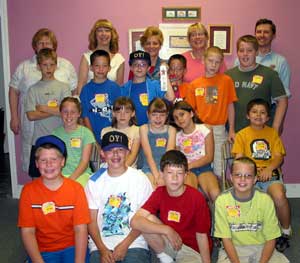
Front Row: Stephen Cardina, Zach Speyer, Michael Vernon, Ricky Boggs
Second Row: Annie Nelson, Alyssa Duncan, Ashley Moffett, Ronnie Eicher, Tommy Scarati
Third Row: Chris Alderson, Bobby Bismark, Tyler Roberts, Brian Bismark, Matt Cook, Alex Harmon,
Top Row: Teacher-Eva Thompson, Principal-Nancy Lann, Teacher-Jan Wunderlich,
Math Coordinator-Karen LeScoezec, and Don Green -
1-2-3 OY! Instructions
The instructions for 1-2-3 OY! includes 10 games and many variations.
1-2-3 OY!
K - 2
1 - Tots OY! - A Child's First Math Game
2 - Line OY! - Easy, Slow; Suitable for Solitaire
3 - Set OY! - A Slow GameK - 4
4 - Quad OY! - Play slow or fast, even solitaire
5 - High Five OY! - Similar to 21 but with many challenging twistsK - 4 - Adult
6 - Flash OY! - The dealer cont the pace, no turns
7 - 2 Quick OY! - Starts slow but watch out, use for competitions
8 - Slap Match OY! - Excellent for School Competitions
9 - Manic OY! - Fast! Fast! Fast!, the title says it all
10 - Panic OY! - The world's fastest math game, lasts only seconds11 - Educator Bonus - For Elementary Students
Visit www.dreamgreen.org to see our other great games and download the free computer version of 2 Quick OY!.
E-mail us your stories or suggestions to:This email address is being protected from spambots. You need JavaScript enabled to view it. If you decide to run school competitions, please contact us.
P.O Box 2347, Weirton, WV 26062
© 1994, 1999, 2000, 2001 Don GreenThe word OY is pronounced as in JOY and is derived from the nautical term AHOY or 'HOY and is used in Great Britain, Australia and elsewhere as a greeting or exclamation to attract attention.
Version 38CONTENTS
The deck contains 90 cards: 5 each numbered 0 to 16 and 5 OY! cards. The symbols on the cards represent the card number and can be used to teach basic numbering. Up to 5 players or 5 teams of players can use one deck.THE DECK AND THE CARDS
OY! cards are either wild cards or have an assigned value depending on the game being played. We recommend a value of 1 for ease of play but for higher level students the OY! could, for example be used as any prime number. The cards left over after hands have been dealt are placed face down in a Stock Pile.TIPS FOR PARENTS AND EDUCATORS
In 1-2-3 OY! instructions can be adjusted to suit the abilities of the players and we encourage you to let players develop their own games. You should begin all games by using only addition and subtraction. For younger players, first remove the cards above 8 or 10 and later add them back into the deck, one number higher at a time, as the players gain confidence, especially when introducing multiplication and division. If you have players who are having trouble with negative numbers use a felt tip marker and mark 2 of each card with a minus sign. Further tips are given in the game descriptions.TEACHERS: Ask all students to shout OY! three times together to get them enthusiastic, then select five students who, with your assistance, will play a selected OY! game for ten minutes. Divide the other class members into teams to actively assist those five students. Resolve all questions and problems before dividing students into groups to play individually or in teams against each other. Younger players or those less skilled in math should play in teams to build confidence. In most games it is much quicker to give each player a stack of cards and let them take 7 cards or what ever number is required than to spend time dealing out cards.
GAME 1: TOTS OY! ( A Child's First Math Game )
Remove the higher numbers and replace them as players become more proficient. Play to win the most cards. All cards are dealt to the players, who hold them face down in a stack. OY! cards are wild. The first player plays the top card from their stack to the table face up. Each player in turn plays one card on top of the previous player's card. If the new card is higher in value than the previous card, or if an OY! card is played, whoever first calls OY! wins all the played cards and places them at the bottom of their stack, then plays the next card. A player who calls OY! incorrectly, must play three penalty cards one at a time. If any of these cards are higher than the previous card, any player can call OY! and win the cards.
Variations: Require that the winning number must be lower in value than the previous number or the next card has to be at least 2 numbers higher or lower to call OY!. Then it must be at least 3 higher or lower and so on.GAME 2: LINE OY! (Easy, Slow; Suitable for Solitaire)
Each player is dealt 6 cards which are held face up in their hands. A LINE of five cards is placed face up on the table. Each player in turn plays 1 or 2 cards on top of the selected LINE cards to form a combination of 3 cards where 2 cards added or subtracted equal a third. Players receive and record points based on the number of each card used including the LINE card/s, then replenish their hands to 6 cards from the Stock Pile. Played cards are left on the LINE. The OY! card can represent any number, but has no value. A player unable to make a combination discards one card to a Discard Pile, replaces it with a new card from the Stock Pile, and misses that turn. When the Stock Pile is depleted, players count their scores to select the winner.
Variations: To play solitaire, play as above but without scoring until you have used all the cards in the Stock Pile. You may also play against time by trying to make the most combinations in a preset period. Consider using multiplication and division.
Tips: To increase the challenge, deal more cards to each player, increase the number of cards in the line and require combinations of at least 4 or more cards.GAME 3: SET OY! ( A Slow Game )
Play to get rid of all your cards. Assign the OY! cards a value. Each player takes 7 cards and the remaining cards are placed in a Stock Pile. In turn, players take one card from the Stock Pile and attempt to make a set of two or three cards which when added and/or subtracted equal the target number, which starts at zero and increases by 1 number after every player has had one turn, until the highest card number is reached and then starts again at zero. The player shows their set and places it on the discard pile. If a set cannot be made, the player calls pass and the next player plays. The game ends when a player has laid out all their cards.
Variations: Use three or four card sets, multiplication and division, and increase the target number past 16. When no Stock Cards remain, the Discard Pile is made into a new Stock Pile.GAME 4: QUAD OY! ( Play slow or fast, even solitaire )
Play to win the most cards. Assign the OY! card a value. The dealer (who also plays) turns a Target Card face up from the Stock Pile and deals 4 cards to the first player who uses addition and/or subtraction of as many of the four cards as they can to equal the Target Number. The player then places the Target Card and Solution cards in their win pile. Any cards not used in the solution are passed on to the next player who receives an additional 4 cards and a new target number. If a player is unable to find a solution the next player receives those 4 cards and 4 new cards and a new target card (placed on top of the old target card). Play until there are no more Stock Cards.
Variations: Consider using multiple target numbers as shown under variations 1 and 2 in HIGH 5 OY!. Allocate a turn time limit for skilled players for fast and very dramatic play. This is best achieved using the G8 Game Timer.GAME 5: HIGH 5 OY! ( Similar to 21 but with many challenging twists )
Unlike 21, players can go higher or lower than the Target Number, which changes each round. Assign the OY! card a value. A dealer gives each player and himself two cards face down, makes a Stock Pile with the rest and turns up a Target Number card. Players try to get closer to the Target Number than the dealer by adding and / or subtracting their cards. Each player can request up to 3 additional cards (hits) but all cards taken MUST be used in their calculation. Once no additional cards are called for and calculations are done, the dealer's hand is revealed. The dealer may also receive up to 3 additional cards. After he has done his calculation, the players reveal their cards. If there are three or more players, any player whose total is closer to the Target Number than the dealer's is a winner. If the dealer and a player have the same total, the dealer wins. If there are only two players and both have the same number or one is higher and the other lower, but both are the same difference to the target number, it's a draw. If a player gets the Target Number with the initial two cards dealt and one of is an OY! card, that player wins and automatically becomes the dealer for the next round. Otherwise the deal passes to the next player after each round.
Variation 1: Turn over 2 Stock Pile cards and add their values for a possible Target Number of up to 32 (16 +16), eg. if the cards are 9 and 12, the Target Number is 21 (9 + 12).
Variation 2: Turn over 2 Stock Pile cards and multiply them for a possible Target Number of up to 256 (16 x 16), eg. if the cards are 9 and 12, the Target Number is 108 (9 x 12). Allow addition, subtraction, multiplication and division plus roots and exponents in solutions. Another option is to use three cards, multiplying the first two and adding the third so players are less likely to throw down cards that are identical to the Target Cards.
Variation 3: Turn over two Stock Pile cards and divide the lower number by the higher number to form a fraction. For example, if the Target cards are 9 and 12, the Target fraction is 3/4.GAME 6: FLASH OY! ( The dealer controls the pace, no turns )
Win the most cards. Assign the OY! card a value. The dealer (who also plays) holds the cards face down and deals cards face up on the playing surface so all the cards can be seen. The first player to see any combination of two or more cards that when added or subtracted are equal to another card shouts OY! and places the cards used in the calculation in their Win Pile. When all the cards have been dealt, players count their cards and the one with the most wins. The player with the least cards becomes the dealer for the next game. If a player shouts OY! but does not immediately have a solution, they can be penalized by not being allowed to call on the next possible solution
Example: If there are 4 cards on the table, a 3,6,1,5 then a player could shout OY! since 6-5=1. This player would place the 6,5 and 1 cards on his or her Win Pile and the 3 card remains on the table.
Tips: Select the weakest player to deal initially so they can control the speed of the game or have a parent or teacher deal only enough cards to find a solution and wait until a player finds it.
Variations: Start playing the games by using only addition and subtraction, but as player's math skills improve use multiplication and division as well. Players could also be required to use 4 or more cards to obtain a solution.GAME 7: 2 QUICK OY! ( Starts slow but watch out, excellent for school competitions.) Play to win the most cards. OY! cards are wild unless played as one of the first two cards when they equal 1. Deal all the cards to the players, who hold them face down in a stack. The first player plays their top card face up onto the table. The second player plays their card so it covers 3/4 of the first card. Before the third card is played, all players mentally add and subtract the 2 cards to obtain 2 possible Target Numbers, eg. if they are 3 and 12, the Target Numbers are 15 (3 + 12) and 9 (12 - 3). Disregard totals above 16 as the highest card is 16. The next player then plays his card covering 3/4 of the second card and completely covering the first card. If the third card played equals one of the Target Numbers (9 or 15 in our example), or if it's an OY! (wild) card, the first player to shout OY! wins all the played cards, adds them to the bottom of their stack, and starts the next round. If the card does not equal either of the Target Numbers, only the top 2 cards are added and subtracted to arrive at 2 new Target Numbers. Players in turn place cards on the Target pile until an OY! is called. A player who incorrectly calls OY! must play 4 penalty cards, 1 at a time. If a Target Number is placed while doing so, players can call OY! and no further penalty cards are required. If there is any uncertainty about who called first, the game continues. A player with no cards left must call the next OY! to continue.
Tips: Before playing a card the player states the next Target Numbers required for an OY! For example, if a 2 and then an 8 card are played, players would say, "We're looking for 6 or 10." (If using multiplication and division as well as addition and subtraction, players would also be looking for a 4 and a 16.) Players can stop calling the numbers out once they're comfortable with doing the calculations. The faster you play the more fun it is. Enforce the rule that players must rapidly pull the cards from the far end of their stack by using their thumb and turn them over and place them on top of the Target pile quickly in such a manner that all players see the card simultaneously. Get the free computer version from www.dreamgreen.org
GAME 8: SLAP MATCH OY! (Very Fast, Excellent for School Competitions)
Play to win the most cards, excluding those in hand. Assign the OY! card a value. Each player takes seven cards. Place the rest face down as a Stock Pile and turn the top card up as the Target Number. Players race to find a combination of two or more cards in their hand, using addition or subtraction or both, that equal the Target Number. The first to throw these cards on the table and then call OY!, wins their cards and the Target Card and places them on their Win Pile. Cards used are replaced from the Stock Pile ( always 7 cards in hand ). The winner turns up the new Target Number from the Stock Pile. If no player calculates a match, or if two players throw down their cards and call OY! simultaneously, a new Target Number is turned up. The next winner collects both Target Number cards. Calling anything, even OY!, before placing your cards on the table disqualifies you from the round. When no Stock Pile cards remain, the player with the most Win Pile cards wins.
Tips: Remove the higher number cards with younger players or when introducing multiplication and division. Use variations 1 and 2 in High 5 OY!.
Variation 1: Instead of giving the win to the quickest player to throw down cards, give it to the player (or team) who is the quickest to use the most cards in their solution. Players must explain their solutions.
Variation 2: Try using nine cards and requiring that at least three cards be used to equal the Target Number.GAME 9: Manic OY! ( Extremely fast, no turns )
Be the first to get rid of all your cards. Assign the OY! card a value. Two Target Cards are dealt face down on the table. Deal the rest of the cards equally to the players who spread them out face up on the playing surface in front of them. There are no turns. After turning over the Target Cards players race to find one of their cards that equals the addition and/or subtraction of these 2 cards. They place their card on top of either Target Card which immediately produces new Target Numbers by the addition and/or subtraction of the 2 top cards. Players go as fast as possible to get rid of their cards and the first to have only 4 cards remaining shouts OY! and wins the game. Any player who suspects cheating can call OY! to pause the game so that a player's solution can be checked. A player who cheats is immediately expelled from the game. If only one player remains, they win the game. If two players place cards on top of the Factor Cards simultaneously, each picks up the card they last played. They then simultaneously place 1 card on either of the factor piles and the game proceeds with new Target Numbers.
Variations: Use 3 Factor Cards. Include multiplication and division.GAME 10: PANIC OY! ( Not for the timid - A very Fast Game)
Assign the OY! card a value. Spread all the cards face up on the table. Players immediately race each other to find the most combinations of 3 cards where 2 of them equal the third. On finding a combination a player places these cards face down in a neat vertical pile in front of them to start their winning pile. The next group is placed on top of these in a horizontal position and then the next group vertically again and so on. This makes it quicker to count and easier to check when no more combinations can be made.
Variations: Require 4 or 5 card combinations. Multiply and divide as well.EDUCATOR BONUS ( For Elementary Students )
Divide the class into pairs and give each pair nine cards. Write a target number on the board. Each pair of students then tries to find two or more cards that when added or subtracted equal the Target Number, and holds them up. The fastest pairs, or the pairs that used the most cards, move to the back of their seat row and the others move forward. At the end of 10 rounds or so, the winners in the rear are all put in the same row on the right-hand side of the class and another 10 or so rounds are played. The fastest pair in the class should now occupy the back seats on the right hand side. With more advanced children, consider using multiplication and division and including negatives and Target Numbers above 16.
CALL TOLL FREE 1-888-GET GAMEDownload the free pc version of 2 QUICK OY (called President's OY), one of the 10 games in the set of 1-2-3 OY!.
-
1-2-3 OY! Some reviews
"(1-2-3 OY!) provides a great way to improve math skills..and great boredom busters for trips, rainy days or family game night." DR. TOY
"Children will have so much fun with the many game variations that they won't even realize they are honing their math skills." National Parenting Publications
To whom it may concern:
I have enclosed a check for 3 more sets of 1-2-3 OY. My children love the one set I presently have in the classroom.
Sincerely,Miss Judy Wright
Handley School
Laporte, Indiana
My husband is quite skeptical when it comes to new games, but he fell in love with 1-2-3- OY! It was hard to drag him away from playing it with our 7 year old daughter. They were too involved in playing it to teach it to me! Great game!....The Tic Tac Chec is a winner, too. We took it to the beach for our vacation and all the kids, aged 5-9 grasped it right away and played it all afternoon.Even the grownups got into the swing of it, and it's not as easy as it seems.Anita Silvert, mother
Yardley PA
Dear Sir,I'm a teacher who needs to order several more sets of OY cards. Please send order form. I use these in classrooms of all ages and with my private tutoring students as well.They (OY cards) are an EXCELLENT math tool. I keep looking for them in every math catalog I get and also in retail stores. Why can't I find them?Sylvia MathisWasatch Elementary
Salt Lake City, UT
I'm writing to tell you how much I love your card game 1-2-3 OY! and how very versatile it is. I bought it at the National Gifted Teachers Conference for my own children, but took it to my school where I teach for some of the brighter students in our special education facility. I was surprised to find my own pupils, who are lower functioning, entranced by this game, when they saw the other kids playing it in the lunchroom. Such multifaceted games are far and few between, and it's a delight to find one that intrigues the very brightest and the less able. The generic students must have a ball with it. Thank you for your vision.Joyce McDermott, teacher
Syracuse, NY
My kids love OY!
Diane Mungle, teacher
Huntsville AL
Dear Sir,
It is fun and the students enjoy fun in studies. I think more and more we need to go with fun activities and games. The following is my analyses of 1-2-3 OY! after using them approximately 1.5 hours per week.
10 % improvement was noted in mental math ability25 % improvement in math confidence
100 % of the students enjoyed playing
I would recommend 1-2-3 OY!
Carol Hecht
St. John's Catholic
Red Bud, IL
Thanks so much for the instructions to the OY Game. My students and I have been playing both of the games that I purchased at your booth, OY and Tic Tac Chec. We have really enjoyed them. The students came in this morning asking to play the games. I brought in my Tic Tac Chec board from home so they would have two of each game.
Thanks again for your time.
Jen Bolly
Education is an ongoing process. Methods and techniques are constantly undergoing revision in order to insurer the best possible education for our children. In today's society where there is so much to learn, it is essential that our children be taught in the most efficient and effective manner possible....Toward this goal, your math game (1-2-3 OY!) is an excellent educational tool, as well as an exciting and fun way to learn the basics of math.Carole Bernardino, Principal
Wellsburg, WV
Having 1 child in Kindergarten and another in 2nd Grade, I am always looking for ways or things for them to do that are educational as well as fun. Finding 1-2-3 OY was the hit of the summer vacation.
The card games are for several age levels, which is a change form the usual “one size fits all” games. Both kids played together and by themselves and even had friends over to play.
One of the best parts of the game is that parents get to be involved and this makes the game a great family gift. Another thing I found was that while there are 10 games you can play, you can also make up your own games as well.
The kids (and even some parents) get to work with addition, subtraction, multiplication and division making the perfect first time math game for any child.
Overall there is no setup or cleanup making a parents dream game. If you are looking for a way to get the kids to learn, than this might be a great place to start.
RATING: **** of **** (Four stars out of Four)
Michael Woznicki 2003
DISCOVER MAGAZINE Vol. 22 No. 9 (September 2001)
Toys
Let's Have Sum Fun
Cardsharps may not acknowledge it, but when it comes to cribbage, blackjack, and most card games, math rules. And now a new card game helps put math back into the spotlight. 1-2-3 OY! ($9.95, www.123oy.com ) uses cards numbered 0 to 16 and wild OY! cards to play 10 different games. One thing most of the games have in common is that the players have to yell "OY!" at some point, so a lack of self-consciousness is a plus. The games center on a target card whose number the players try to reach using their own cards, usually by adding, subtracting, multiplying, or dividing the numbers in their hands. For those who can do more advanced math on the fly, exponents and roots can be added. In an alternate version, players take turns flipping cards from their stacks, held face-down, onto a discard pile. The top two cards are added and subtracted to get two target numbers, and if the next card equals one of those numbers, the first player to shout OY! wins the stack.
-
Dream Green
Welcome to Dream Green original games designed and produced by Don and Sharon Davis Green since 1990.
For non US orders please contact us with your address and items desired so we can find the best shipping options.Thank you
Capt. Don & Sharon -
Dream Green
Welcome to Dream Green, award winning games