
Noble Celts
-
Dream Green
Welcome to Dream Green original games designed and produced by Don and Sharon Davis Green since 1990.
For non US orders please contact us with your address and items desired so we can find the best shipping options.Thank you
Capt. Don & Sharon -
Dream Green
Welcome to Dream Green, award winning games
-
Gayle Adams Chess Pieces
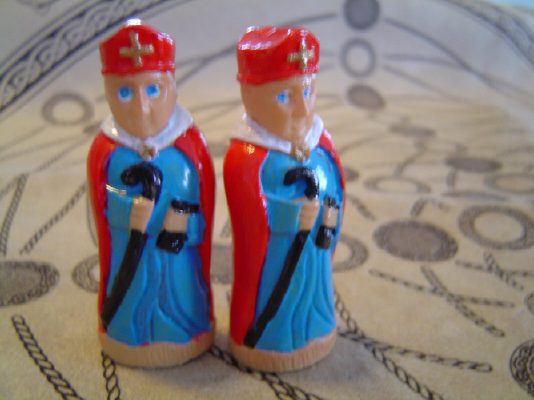
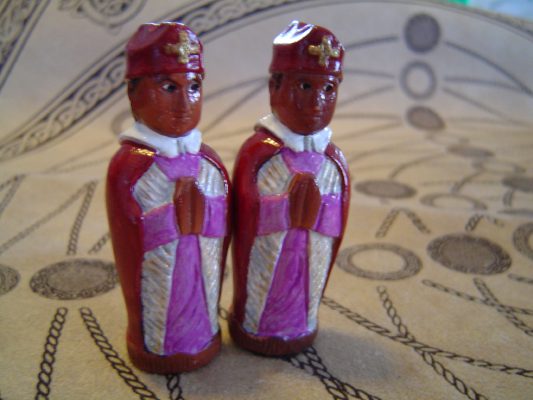
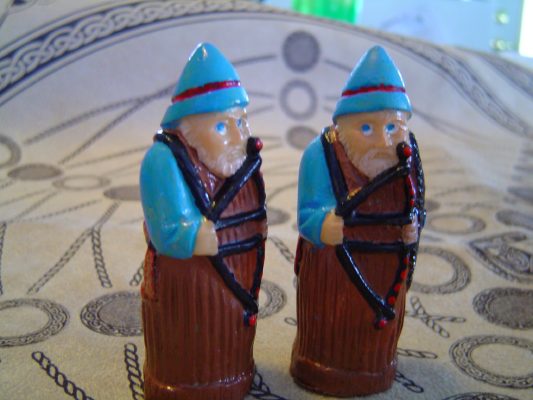
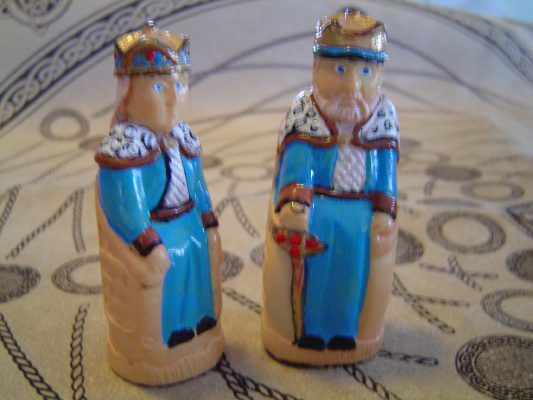
Thanks to artist Gayle Adams at http://www.bygayle.com for painting and submitting these pictures of her Noble Celts Chess pieces. If you have painted yours please let us know and we will put them up.
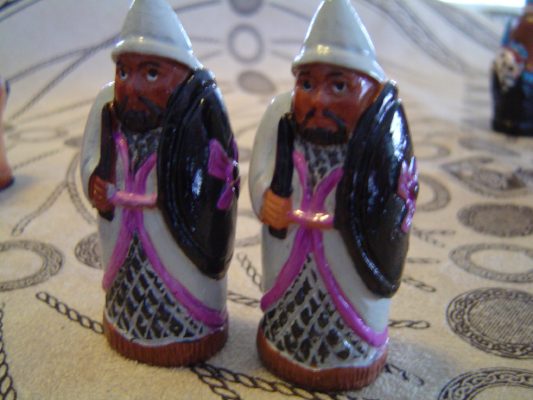
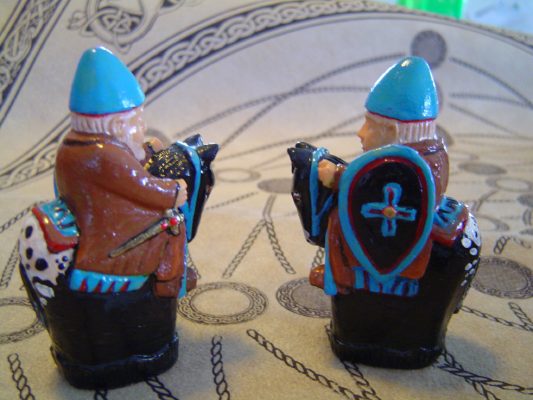
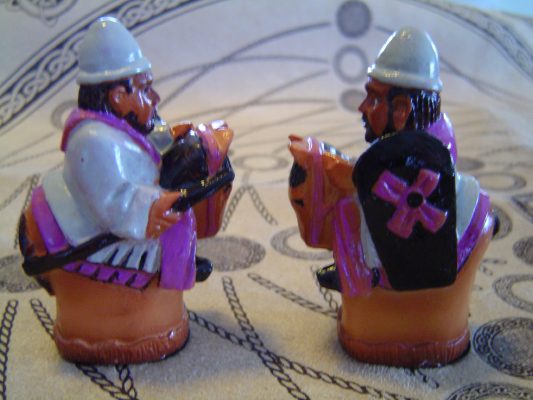
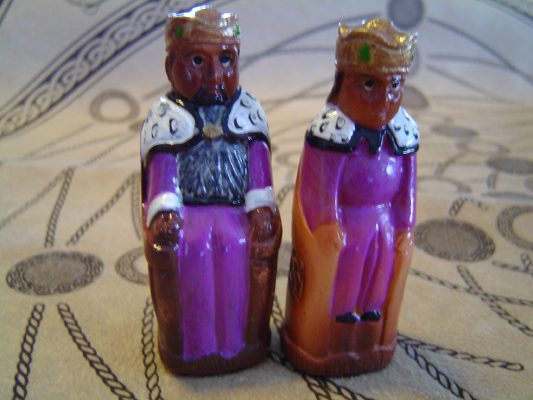

-
NCC Instructions
NOBLE CELTS is often referred to as siege chess where the center of the board is thought of as a castle. Pieces are moved on their turn in their accepted chess manner. When first playing, set up a standard chess board next to Noble Celts and on each turn duplicate the moves on both boards. On the Noble Celts board, as in European chess, the white queen is placed on a white circle (square) and the black queen on a black circle opposite it and the rest of the pieces are placed on either side of them. There is no advantage to playing from the inside or outside. The Gaelic term for each piece is included as a tribute to the Celtic influence on the design.
KING (righ) - Moves one circle in any direction, unless castling.
QUEEN (banrighinn) - Can move the same as the rook (castle) or bishop.
ROOK (caisteal) - Derived from the word Ruhk (Indian & Persian) meaning chariot. It is moved horizontally around the board within the same row alternating between light and dark circles (think between the ropes). For example if your piece starts 3 circles in from the edge, its final position must also be 3 circles in from the edge. It can also move vertically, that is towards the center or away from the center of the board.
BISHOP (easbuig) - Moves diagonally along the ropes connecting circles of the same color, either towards or away from the center, never both directions in a single move. These ropes trace the Fibonacci Spiral, first explained mathematically in 1202 by Italian Leonardo Fibonacci and common in nature such as in spiral seashells.
KNIGHT (ridir) - Uses a horizontal and vertical combination moving either two circles horizontally and one vertically or one circle horizontally and two vertically.
PAWN (ceatharnach) - Possibly derived from the word Piyada (Indian & Persian) or Peon in Spanish, both meaning foot soldier. The first move for the piece can be one or two circles vertically. Subsequent movement is restricted to one circle vertically forward, unless the pawn is capturing an opponent's piece which is accomplished by moving one circle diagonally. Pawns are promoted to any other piece besides a king upon reaching the opposite side of the board. A queen is normally selected.
CHECK - In European Chess when it becomes possible to capture the opponent's king one says check, unless you are playing a master player who might take it as an insult, since it would be obvious. A player cannot normally move into check, however, for a quick game don't call check. This Assassin's Rule rule must be agreed upon at the start of the game.
CHECKMATE - The word is derived from Persian and Sanskrit and means "King Lost". The game objective is to get the opponants’ king in CHECK and there is no position to which it can move without also being captured.
CASTLING - The king is always moved 2 places towards a selected rook and the rook is moved over the king and placed along side it so long as there are no pieces between them, neither piece has been moved and there is no opponent's piece that could capture the king in its original circle, the circle he moves through or the circle that he ends the turn on. In Noble Celts it is possible to "Castle" in 4 different ways where each castle can be exchanged with the king in both directions.
OPTIONAL RULES: Use to make the game faster.
1/ - INDIAN RULES - The main difference between the original Indian game of chess known as Shatranj and traditional western Chess is that in Shatranj, a win can be achieved by taking all of your adversary’s pieces, except the King - you do not need to force checkmate.
2/ - ABDICATION - This rule is derived from the Chinese Chess rule of "Nine Palaces". If your king is moved out of the royal court, the 8 inner or outer circles where the royal pieces are first placed, you forfeit the game.
3/ - ASSASSIN'S RULES - A king can be captured without saying check.
4/ - STALEMATE - Play by the rules of modern Chinese chess (XiangQi). Moving the same piece repeatedly between the same 2 spaces is forbidden and if this is your only option, you must forfeit the game.
STALEMATE: Used when not playing by the optional rules
If a player's only move is to place his own king in check, but its current circle is not threatened the game is a stale mate (tie)). A tie also results if the pieces remaining on the board make checkmate impossible.
ILLEGAL MOVES: A piece cannot be moved around the board back to its original position or across the center of the board. A queen or rook cannot be said to be going around the board continuously to force a stalemate.Link describing other forms of chess including those from China (Xiang Qi), Japan (Shogi), Burma (Sittuyin), Tailand (Makruk) and the original Indian games of Shaturanga and Shatranj.
-
Noble Celts Circular Chess
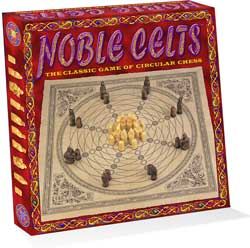
Dream Green is proud to bring you Noble Celts Chess by award-winning game inventor and artist, Don Green.
Noble Celts is a richly decorated Celton-Saxon styled circular chess game. Chess was played on a circular designed board centuries ago but this version mostly disappeared during the Dark Ages. This could be as a result of the many occasions that chess has been forbidden . Only in recent years has this form of chess been rediscovered and this design combines beautiful artistry with dynamic play. Although the chess pieces still move as in European Chess and those chess rules apply, the lack of side edges on the Noble Board makes this variant a vibrant way of playing an ancient game.The board is faux leather measuring approximately 26 x 26 inches. The abstract animal and interlocking braided cord designs of Northern Britain and Ireland harmonize beautifully and are complemented with exquisite chess pieces from an original set hand carved by Don Green. Some references to the development and history of chess and the pieces are included. Many more can be found on this site and the internet. The chess pieces are cast resin.Whether you're a chess enthusiast or a novice, Noble Celts is an interesting twist on a classic game which will keep you entertained for hours! -
Religion and Chess
See also a history of the prohibition against cards and other games
Religion and Chess by Bill Wall
Chess (shatranj) was a legal issue after Mohammad died in 642 A.D. In 655 his son-in-law, Caliph Ali Ben Abu-Talib disapproved the game for his sect of Muslims because of the graven images.
In 680 the 50th rule of canons was interpreted as forbidding chess. But the caliphs themselves played and had chess players in their circle of influence. Legal scholars debated the merits of chess. It was legal to play chess if not played with items of chance (dice) and there were no betting or gambling on chess.
It was still disapproved in 725 by Sulaiman ibn Yashar but still popular among caliphs, especially when they moved their capitol to Baghdad in 750 and took their top chessplayers with them.
The caliph al-Mahdi wrote a letter to Mecca religious leaders to give up gambling with dice and chess in 780, but he died in 785 and caliph al-Rashid came to power who was an avid chess player.
By 810 the top chessplayers in the world were known and recognized and all had sponsors by powerful caliphs. In fact, the word Grandmaster was introduced by caliph al-Ma'mun in 819 AD.
Chess was getting serious in India as well but tolerated. By 900 there was a problem of players actually wagering fingers in their chess matches - you lose, you cut off a finger.
The Egyptian al-Hakim banned chess in Egypt in 1005 and ordered that all chess sets and pieces be burned in Egypt.
Chess had picked up in Europe and pretty soon many of the clergy was spending more time playing chess than saving souls. In 1061 Cardinal Damiani of Ostin forbad the clergy from playing chess. He died in 1072 and chess was resumed in his domain.
By 1093 the Eastern Orthodox church condemned chess. The Church stamped out chess in Russia as a relic of heathenism.
In Europe some members of the clergy thought that receiving a "check" in chess was similar to committing a sin which one was able to redeem. A checkmate was similar to committing a sin that was perishable, and thus deadly.
By 1100 chess was accepted as a regular feature of noble life in England. It was even a knightly accomplishment to play chess in 1106 under Petro Alfonsi. Chess was played by the upper classes and excluded women from playing the game.
By 1115, the emperor of the Byzantine empire was a chess addict. Despite that, it was still being banned in the churches up to 1125. John Zonares, a former captain of the Byzantine imperial guard, became a monk and issued a directive banning chess as a kind of debauchery.
St. Bernard (1090-1153) forbade his knights templars from playing chess.
Chess become more popular during the crusades, but Alexander Neckam, a British author, condemned chess as being frivilous.
By 1195, the Jews were seriously involved in playing chess, but Rabbi Maimonides included chess among the forbidden games for jews.
In 1197 the Abbot of Persigny was warning folks not to play chess.
In 1208 the bishop of Paris, Odo Sully, banned chess in Paris to his clergy.
It was also forbidden in Worcester, England in 1240 by the religous leadership.
In 1254 St Louis of France restricted chess to laymen. Provinical councils were forbidding chess in France (Beziers).
King Henry III (1207-1272) instructed the clergy to leave chess alone "on pain of durance vile."
In 1291 the Archbishop of Cantebury, John Peckman, was forbidding chess. He threatened to put anyone on a diet of bread and water if they played chess.
Priests were forbidden to play chess up to 1299. The Clementine Kormch wrote a series of directions of priests. It included no chess play.
Chess was forbidden in Germany in 1310 after the Council of Trier.
In 1322 the Jewish rabbi Kalonymnos Ben Kalonymous condemned chess. By 1328 the Jewish laws were intrepreted by some Jewish leaders that chess could be played, but not for money.
Chess was still forbidden in Germany up to 1329 after the Synod of Wurzburg.
Charles V (1337-1380) of France prohibited chess.
In 1380 William of Wickham (1324-1404), founder of New College, Oxford, and Winchester College, forbade chess. He was the Bishop of Winchester and the Chancellor of England twice.
Charles VI (1368-1422) of France continued to forbid chess. He later became unsane.
In 1405 John Huss (1369- ), Bohemian religious reformer, sought repentance for loss of self-control at the chess table during a game in Prague.
In 1416 the Jews of Forli, Italy relaxed a bit and forbade all games of chance except chess.
In 1420 Werner von Orseln, the Grand Master of the Knights of the Teutonic Order, abandoned the prohibition of chess on the grounds that chess was a proper amusement for a knight.
By 1476 chess was being played in France again under Charles the Bold.
In 1495 the Inquisition saw victims of persecutions stand in as figures in a game of living chess. The game was played by two blind players. Each time the captured piece was taken, the person representing that piece was put to death.
By 1500 chess was a recognized pastime for Jews on the Sabbath.
In 1549 the Protohierarch Sylvester wrote that those who play chess shall go to hell and be accursed on earth. This was documented in his work Domostroi (Household Goverment), a book of principles of family life. This was the first printed book in Moscow.
In 1550 Saint Teresa of Avila, a Spanish conventical reformer, mentioned chess in her writings to illustrate ethics and chess. The Church authorities in Spain proclaimed her patron of chessplayers.
In 1551 Czar Ivan IV (1530-1584), Ivan the Terrible, of Russia banned chess.
The leading clerics compiled the Stoglav Collection (council of the Hundred Chapters) in 1551, which prohibited chess in Moscow. This same document prohibited shaving as well as beards were said to imitate the visage of God and to distinguish Orthodox males from women.
In 1575 a plague hit Cremona, Italy. Afterwards, all games were considered evil and the cause of their troubles. All games but chess were banned.
Chess was still banned in Russia in the 17th century. In 1649 Czar Alexei (1629-1676) found some players playing chess and had them whipped and imprisoned.
The Puritans were against chess and discouraged chess play.
Religious leaders who have played chess include Thomas Becket (Archbishop of Cantebury), Charles Borromeo (Bishop of Milan), Pope Gregory VI, Pope Innocent III, Pope John Paul I, Pope John Paul II, Pope Leo X, Pope Leo XIII, Cardinal Richelieu, and Billy Graham.
In 1981 chess was forbidden in Iran as it encouraged gambling (haram). The chess players went underground with their boards and pieces. In 1988 the Ayatollah Ruhollah Khomeini (1900-1989) issued a religious decree (fatwa), permitting chess play for Muslims as long as it was not played for the purpose of gambling (haram) and it does not delay the obligatory prayers or neglects other duties. The Ayatollah changed his mind after admitting that chess had its high educational and intellectual values. Chess made a comeback, spawning chess parks, chess palaces, and chess masters. In 2000, an Iranian became a world chess champion. In October, 2000, the World Girls' Chess Championship for 12 and under was won by Atousa Pourkashian of Iran at the tournment held in Madrid, Spain. Iran also produced a recent World Boys' Under 10 Champion. Today the Chess Federation of Iran occupies one of the best buildings among all sportive federations in the country. All over the country there have construction of chess clubs.
Prior to the Ayatollah, Iran, under the Shah, was the only Islamic country that organized chess and participated in chess tournaments, including the 22nd chess olympiad in Israel in 1976 (in Haifa).
In 1996 chess and other clubs were banned from some high schools in Salt Lake City, Utah. Most of the school board is Mormon which condemns homosexuality. Rather than let gay high school students form an organization, they banned all nonacademic clubs. School board members said federal law gave them only two options: allow all extracurricular clubs or eliminate them all. Some 30 clubs, including the chess club, are banned for 1996-97.
The Taliban believed chess was a form of gambling and distracted people from saying thier prayers. When the Taliban caught people playing chess, they would burn the chessboard and pieces and put the players in jail. For five years (1996-2001), Afghanistan was the only place in the world where playing chess was illegal. It was banned by Mullah Mohammad Omar, the supreme leader of the Taliban. geovisit();
 <img src="http://visit.geocities.yahoo.com/visit.gif?us1188482959" alt="setstats" border="0" width="1" height="1">
-
The History of Chess Pieces
For Show Not Play: Glass Chess Sets
The history of the game of chess is a fascinating story that begins around 600 AD. For centuries, scholars and historians have debated whether variations of the game were first played in India, Persia or China. Most authorities feel the closest ancestor to chess was an Indian game called “Chaturanga” which means the four divisions of the Indian army. It was a four handed game of war with the board as the battlefield. The pieces were figural chessmen, depicting the Indian army of elephants, horses, chariots and foot soldiers that protected the raja. There was no queen in these games. Her position was filled by the vizier, the minister to the ruler.
As the game of chess spread throughout the ancient world, the rules and shape of chess pieces changed. It was played in Persia in the 7th century and spread throughout the Arab world by the 10th century. Although the teachings of Islam only discouraged the representation of human figures in art, makers of Arabic chess sets chose to make symbolic, almost abstract chess pieces. The Islamic pieces were conventional and simplified and easy to use. It is believed that chess reached Europe through Spain after the peninsula was conquered by the Moors in 711 AD or through the northern trade routes. By the 10th century, chess was played all over Europe and the pieces again became figural, often representing medieval armies. The queen, for the first time, became the companion to the king, replacing the Indian and Arabic vizier. It would not be until the 15th century that the rules of chess were again revised and the queen was given her power to move around the board.
The first chess pieces were carved from ivory, bone, and wood. Later examples were made of ceramic, porcelain, gold, silver, bronze, pewter and glass. The earliest glass chess pieces were made during the Islamic Empire around the 9th century. Several small abstract examples exist in museums and private collections. One tiny piece, in the collection of the Corning Museum of Glass, was made from a dark opaque glass with red and green trailed decoration. Its simple design is in keeping with traditions of the Islamic religion.
The shape of chess pieces were figural in Europe and were made for centuries out of many materials other than glass. Elaborate representational sets made for presentation, not play, were popular during the 17th century. These ornate sets, often depicting scenes from literature and history, were status symbols of the wealthy. By the 19th century, fragile decorative glass chess pieces were created in Italy on the Venetian island of Murano. There seems to be little evidence of glass chess pieces being made in Europe before the 19th century. Due to the fragility of delicate glass chessmen, the sets were most likely never used. Glass chess sets continued to be made into the 20th century by glass companies and glass artists on the island of Murano and in Venice, Italy. The sets ranged from highly figural to abstract.
Probably the most recognized design of all chess sets is called the Staunton set. The Staunton set design was actually created and patented by chess makers John Jaques and his brother-in-law Nathaniel Cook in England in 1849. Howard Staunton was the English chess champion who won the equivalent to the world title match in Paris in 1843. Cook convinced Staunton to endorse the design. Staunton agreed, and the use of his name is believed to be the first commercial product endorsement. The shape, weight and all over feel of the Staunton set was so well received that it was selected in 1924 by the World Chess Federation for use in all international chess tournaments. The Staunton design was originally made from wood, but at least one factory in Italy made glass Staunton sets.
Other important glass companies made chess sets during the 20th century. The famous Waterford Crystal of Ireland made glass sets incorporating their elaborate cutting to differentiate between opposing sides. The Cristalleries de Saint Louis of France created clean angular chess pieces with sharp cut points on the crowns of the king and queen, distinguishing the opposing sides by frosting. Glass companies in Czechoslovakia and Austria also manufactured chess sets.
Some non-glass companies marketed their products in glass chess pieces. The most logical was the perfume maker, Mary Chess. Capitalizing on her name, she sold a variety of scents in chess pieces which, when collected, comprised a complete chess set. The Wheaton Glass Company of Millville, New Jersey produced the glass bottles and pressed figural stoppers for Mary Chess from 1946 to 1948. In the 1970s, Avon Products, Inc. sold several of their men’s colognes in a select group of opposing chess pieces. Plastic figural tops covered the lids of the simple bottles, creating the chess characters. Wheaton Glass Company also made glass bottles for the Avon chess pieces. The Italian distillery Mazzetti d’Altavilla in Altavilla, Monferrato, developed chess pieces as promotional items. To distinguish between the opposite sides, the decorative bottles were filled with two different Grappa flavors.
“Put togethers” is an unusual category of chess set collecting. For centuries, people who could not afford commercially made chess sets made up their own. Any type of material could be used from stones to sea shells. Glass “put togethers” have been made from salt and pepper shakers and perfume bottles. Although they appear a little curious, chess sets have also been created by putting together appropriately sized miniature liquor bottles. In the movie “Our Man in Havana,” produced in 1960, Alec Guinness played with a put together set of miniature liquor bottles. Another unusual glass chess set that looks like glass picks in sand was made by glass artist Dumitru Costea. His design was actually based on a type of chess set called the Dieppe set. Dieppe is a town in France where an ivory carving industry thrived during the 18th century. Chess sets of intricately carved ivory were a product of Dieppe, usually depicting French characters. Spike sets were made from the left-over ivory and were played in the sand.
There was an explosion of glass artists making chess sets during the late 20th century. Continuing the unusual subject matters for chessmen that became popular in the 17th century, today’s artists are only restricted by the limits of their imagination. Artist Milon Townsend has created sets ranging from fanciful insects to the dazzling New York skyline. Gianni Toso’s remarkable talent can been seen in his religious and Pulcinello sets. Tom Patti’s background of industrial design and understanding of the beauty of minimalism is reflected in the Jaeger set. Chess has also been used as a motif in glass. Large individual chess pieces have been made in Murano, Italy and at the Steuben Glass Works of Corning, New York. Artists such as Milon Townsend, Wendy Saxon-Brown and Maurice Heaton have used the theme of players contemplating their next move in their work.
Although glass was never a common medium for chess sets, its use for chessmen dates back for centuries. It would not be until the 20th century that glass artists designed fragile, imaginative glass chess sets, for show, not play.
-
The Lewis Chess Set
The Lewis Chess Men(Article Source )
The 11th century Chess pieces (The Lewis Chessmen) made from walrus tusk and found on the beach in the parish of Uig on the Isle of Lewis (Hebrides) and now in the British Museum, were found in 1831 buried in a sandbank in the Isle of Lewis, the largest island of the Outer Hebrides (Scotland). The sea carried away the sandbank uncovering a mysterious building (a small brick oven) that had been buried under the sand.
Lewis Chessmen pieces

Carved of walrus ivory, they may have come from Iceland, although recent investigation suggests that the Lewis Chessmen may have originated in Trondheim, the medieval capital city of Norway, and home to the Norsemen during the eleventh and twelfh centuries who were the overlords of the Isle of Lewis. It seems that they brought the Chessmen with them from Norway when they voyaged to the island. Some authorities date them to the 12th century. There were four sets, not all complete.
According to legend, they were stolen by a sailor from a ship anchored in Loch Hamnaway soon after the year 1600. A shepherd known as Ghillie Ruadh murdered the sailor to get the treasure, but fearing discovery, carefully buried the pieces. A few years later he was hanged in Stornoway for another crime, and is said to have made a dying confession to the murder of the sailor.
A local peasant,Calum nan Sprot, working nearby found what he concluded to be a collection of Elves and Gnomes. The superstitious highlander flung down his spade and fled home in horror. Superstition in the Isle of Lewis had survived in a powerful form. Thus, when the peasant first looked at the group of singular little ivory figures, it was natural that they should appear as the pigmy sprites of Celtic folklore. However, he was induced by his wife to return to the spot and take the figures home.
He sold them to a local collector who realised they were Chessmen pieces. There were 78 pieces in all, belonging to eight or more sets. 67 are now in the British Museum and the rest in the National Museum in Edinburgh. Experts are unanimous in regarding them as "The most astonishing collection of ancient Chessmen in existence".